
An 8 a.m. appointment in Alba feels simple until you are standing at a stop at 6:40, squinting at a timetable you have never used before. Early service here is dependable but sparse: one missed bus can mean a forty-minute wait, and a ticket bought in the wrong place can stretch that further. What follows is a plain walkthrough for first-time early riders — where tickets come from, how to read the schedules without guessing, how much cushion to build in, and what to check if you use a wheelchair, push a pram or simply need to sit down on the way.
Buy the ticket before you need it
The most common beginner's mistake is not the route. It is arriving at the stop with no ticket, assuming the driver sells them. On many local services the driver does not, or sells only a single at a higher rate. Sort this out the day before your first early trip and the morning becomes much calmer.
Tickets are generally available from tobacconists, newsagents, some bars and the ticket machines at the station. If you are staying a few days, buy a small strip of singles in one go and keep them in your wallet with your keys. If you are coming back the same day, ask for a return or a day ticket — it saves you queueing for a tabaccheria that has already closed by the time you get back.
- Paper tickets: usually need stamping in the machine on board or at the stop before you travel. A ticket that has not been validated can be treated as invalid.
- Digital tickets: activate them just before boarding, not hours earlier, if the app works on a countdown.
- Contactless and cards: useful where accepted, but do not assume the early bus takes them. Bring a backup.
- Keep the ticket until you have left the vehicle. Inspectors work early too.
Fares are banded by zone and kept deliberately modest, but they change. Read the sheet at the ticket window or the operator's own page rather than trusting what a friend paid last year.
Learn to read the morning timetable properly
A timetable is not one document. It is three or four overlapping ones: weekday, Saturday, school-day and holiday. Early morning is exactly where these differ most. The 6:50 that runs Monday to Friday may simply not exist on a Sunday, and the school-day extra that helps you on a Tuesday disappears in August.
Start with the column headings before you look at any numbers. Then find your stop row. Stop names are the second trap: the same corner can appear as "Piazza X" on one sheet, "Via X" on the app and "X (fronte chiesa)" on the printed sign. Read the stops either side of yours to confirm you have the right line.
- Times at intermediate stops are estimates; the departure time from the terminus is the hard one.
- Know whether your stop is the one outside the station or the one in the town centre — they are not always served by the same runs.
- Screenshot the timetable the night before. Mobile signal at 6:30 is not guaranteed.
- Check the date type: weekday, Saturday, school day or public holiday.
Keep a printed copy if the stop has a notice board. Paper does not run out of battery at the moment you need it most.
Build a buffer that survives a late bus
Five minutes is not a buffer. It is optimism. For the first departure of the day, be at the stop ten minutes early — the bus has not yet been delayed by traffic, but the driver is also not waiting for you. For any connection, allow one full headway: if the next bus is twenty minutes behind, give yourself those twenty minutes, not four.
Morning traffic in Alba thickens noticeably as the school run begins, so a bus that sails through at 6:20 can crawl through the same streets at 7:40. If your appointment is at nine and the ride takes twenty minutes, take the 8:15 rather than the 8:35. The point is not to arrive early and stand around. It is to arrive early enough that a ten-minute delay is an inconvenience rather than a crisis.
Treat the last possible service as a fallback, never as the plan. The last possible service is the one that fails on the day you cannot afford it to.
Add the walk from the stop to the door, too. Two hundred metres with a heavy bag and an unfamiliar street can easily take five minutes more than you expect.
The 6 a.m. bus: small habits that help
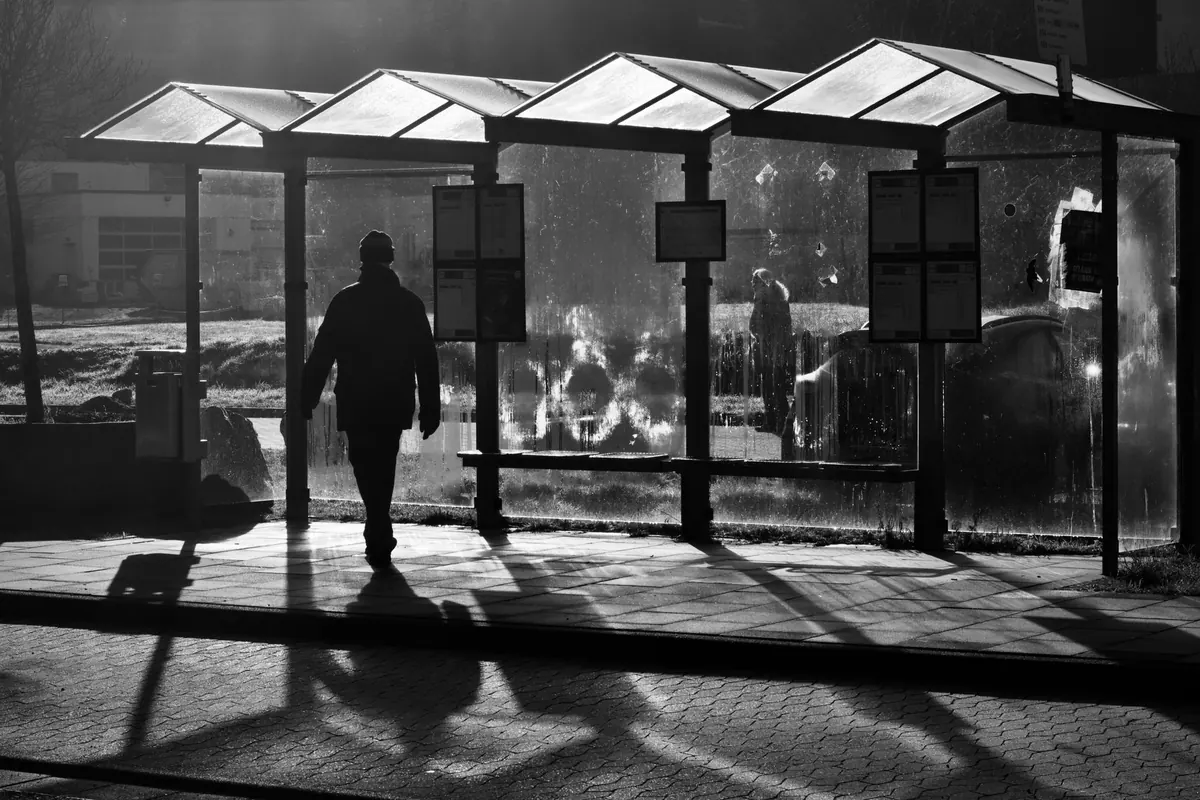
Early stops are quiet, and quiet stops are easy to miss. Stand where the street lighting is good and where the driver can see you from a distance. A raised hand and a step towards the kerb do more than any app notification. Some drivers will pass a stop where nobody is visibly waiting.
Have your ticket in your hand before the bus arrives, not buried in a rucksack. Board at the front, validate, and take a seat — early buses are rarely full, so you can sit near the front and watch your stop come up. If you are unsure where to get off, tell the driver when you board. In a small city, that usually works.
Note which side of the street your return stop is on and confirm it is the same line. Morning routes sometimes use different stops in each direction, and the walk between them is not always obvious in the dark.
Trains from Alba station in the early hours
The station is the better option for longer journeys, with regional services toward Turin, Asti and Bra. Early departures exist, but they are not frequent, and some routes need a change. Check whether the connection is a real one: a five-minute gap at an intermediate station is not a connection if the first train is late.
Buy online in advance or at the machine, and validate paper tickets in the small machine on the platform before boarding. Regional trains have no seat reservations, so arriving a few minutes early is worth it if you want to sit and work. Announcements are often in Italian only — a few words go a long way:
- binario — platform
- ritardo — delay
- soppresso — cancelled
- arrivo / partenza — arrival / departure
If a strike is called, services are thinned rather than stopped entirely, and guaranteed windows apply. Check the day before and have an alternative in mind. Also check the departure board on the platform rather than only the app — platforms do change at short notice.
Accessibility: what to check before the morning of
Newer buses are low-floor and can often kneel at the kerb, but not every stop is level and not every kerb is generous. If you use a wheelchair or a rollator, ask the driver to deploy the ramp; allow an extra minute for it and do not feel rushed by the queue behind you.
For rail, ring ahead if you need assistance boarding or alighting. Lifts go out of service, and an alternative route across the tracks may be long or unavailable. It is worth confirming the day before rather than discovering it at 6:45. If you have a visual impairment, ask the driver to call your stop; on quieter early runs they usually will.
Prams are best folded where the aisle is narrow, and the designated space near the middle doors is shared with wheelchair users, so leave it clear if someone needs it. Anyone who needs to sit should aim for the seats nearest the driver, where it is easier to ask questions and to be seen.
When the bus does not turn up
Wait a few minutes past the scheduled time before deciding anything. Then check the operator's app or the departure board, and ask at the station if you are near it. If you are going to be late, message the person you are meeting early — a short note at 7:20 is worth far more than an apology at 8:15.
Save the number of a local taxi firm in your phone before you need it, and know roughly where the rank sits. It is also sensible to check whether your appointment can be moved to a later slot if the first service of the day is cancelled; many offices in town are flexible in the early morning if you call ahead.
A short pre-departure checklist
- Confirm the day type — weekday, Saturday, school day or holiday — and read the right timetable.
- Buy and, where required, validate your ticket the day before.
- Identify the exact stop name and which side of the street it is on.
- Set your alarm for the earlier service, with a ten-minute buffer at the stop.
- Screenshot the timetable and save a taxi number.
- For rail, check the platform, any changes, and whether assistance is needed.
Do those six things once and the second early morning becomes routine. Alba's early network rewards a little preparation and punishes a lot of improvisation — which, fortunately, is a problem you only have to solve once.
Photo: Peter Dyllong / Pexels